
Gastroscopy
- Home
- Gastroscopy
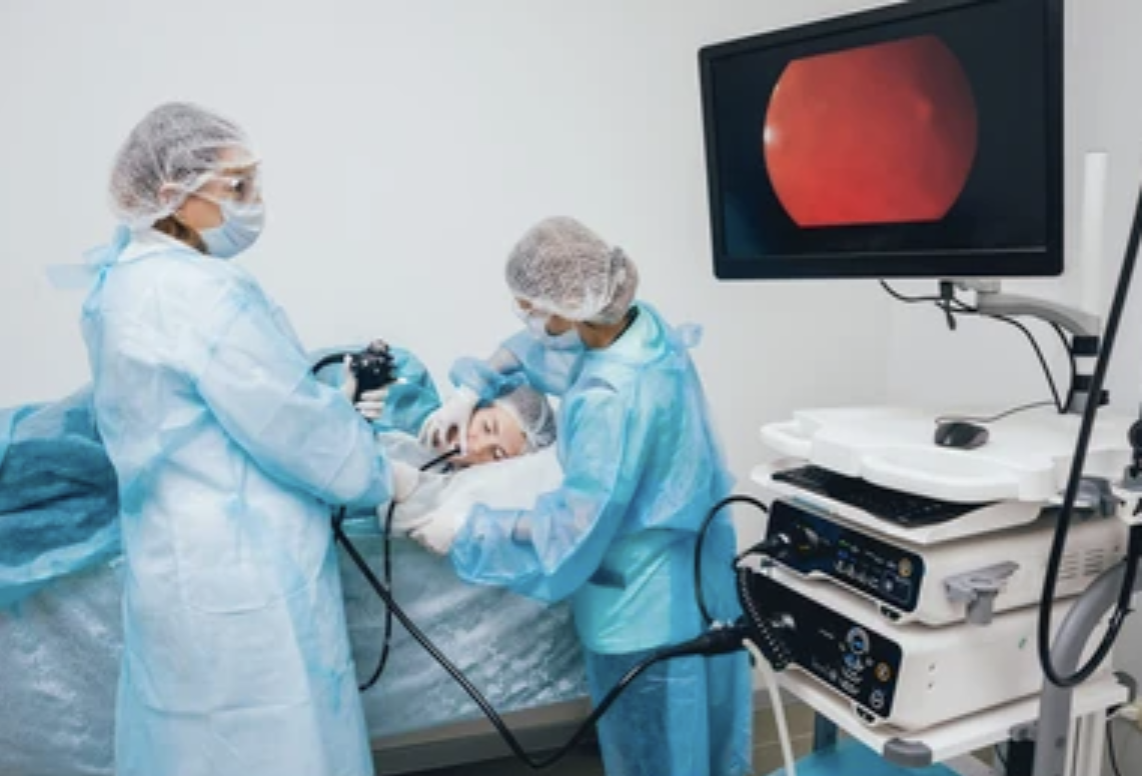
Gastroscopy
What is a gastroscopy?
A gastroscopy is a test that allows your doctor to look inside your oesophagus (gullet), stomach and the first part of the small intestine (duodenum). The test is done using a narrow, flexible, tube-like telescope called an endoscope. The endoscope is passed through the mouth and into the oesophagus through the stomach and into the distal duodenum. The test may also be simply referred to as an (upper GI) endoscopy, or OGD (oesophago-gastro-duodenoscopy).
Why have a gastroscopy?
A gastroscopy can help find out what is causing symptoms such as indigestion, upper abdominal pain, vomiting or bleeding. It is also used to check for certain gastrointestinal conditions such as inflammation, ulcers and early signs of cancer. Sometimes, a gastroscopy is used to confirm the results of other tests – a barium meal, for example.
During the procedure, DrMerrett may take one or more biopsies (small samples of tissue) for examination in a laboratory. Testing for the presence of Helicobacter pylori (the bacterium that can cause inflammation, ulcers and increase the risk of stomach cancer) can be done by taking a biopsy or by a breath test on the day before or after the endoscopy.
If there is a narrowing of the lumen (usually the oesophagus) for any reason this may be treated at the time of endoscopy with a dilatation.
What are the alternatives?
Depending on your symptoms and circumstances, it may be possible to diagnose your condition using a different test.
- Barium meal – involves drinking a fluid containing barium (a substance which shows up on X-rays). X-ray pictures of your upper body can then show the inside of your oesophagus, stomach and duodenum. A gastroscopy may still be needed.
- Oesophageal pH / Impedance & Manometry – This is available at our Gastrointestinal Investigation Lab. This involves placing a thin silicone tube down the oesophagus to take pressure readings. This is often used in conjunction with Endoscopy to diagnose Gastroesophageal reflux, cause of chest pain and swallowing disorders.
- Ultrasound – high-frequency sound waves are used to produce images of the inside of your body.
- CT scan – X-ray images are used to produce two and three-dimensional images of the inside of your body. For more information, please see the separate Bupa health factsheet, CT scan.
- MRI scan – magnets and radiowaves are used to produce two and three-dimensional pictures of the inside of your body.

Preparing for the procedure
Gastroscopy is routinely performed as a day case however some patients will have this test as part of a more prolonged hospital admission.
For your doctor to see the lining of the stomach and duodenum clearly, your stomach needs to be completely empty. To help clear it out you must follow the fasting instructions in your admission letter. In general, you must not eat or drink for eight hours before the test. You may be allowed to sip clear fluids for up to two hours before the procedure. Your hospital will give you detailed advice beforehand.
If you normally take medication (eg tablets for blood pressure, diabetes), continue to take this as usual, unless your doctor specifically tells you not to. If you are unsure about taking your medication, please contact the hospital.
When you arrive at the hospital, you may be asked to answer some questions about your health and any medicines you are taking. You should tell your doctor or nurse if you are allergic to any medication and whether you suffer from asthma, hayfever or eczema.
It’s important to tell your doctor or nurse if you have any dental crowns, bridges or loose teeth. These can be vulnerable to damage by the endoscope, although special care will be taken to prevent this.
About the procedure
You may be asked to take off your shirt or top and put on a hospital gown. If you have them, you may be asked to take out any removable dentures or dental plates and contact lenses. You will be asked to take off your glasses and jewellery. These will be kept safe for you.
Nearly all patients will have sedation (light anaesthetic) for their Gastroscopy. This will be supervised by an Anaesthetist who will watch closely at all times monitoring all the vital signs. A small plastic tube (cannula) will be placed into a vein on the back of your hand. The sedative will be injected through the cannula, and you should start to feel relaxed and drowsy almost immediately. Sedatives can sometimes affect your breathing. While you are sedated, the amount of oxygen in your blood will be monitored constantly through a small clamp on your finger and you may be given extra oxygen through a mask.
With you resting on your side, the Anaesthetist or Nurse will place a mouth guard over your teeth before carefully putting the endoscope into your mouth. Dr Merrett will gently pass the endoscope into the oesophagus and down towards the stomach. You should be able to breathe normally during this test. A nurse will help by using a suction tube to remove excess saliva from your mouth during the procedure.
Carbon Dioxide is used to expand and the stomach to improve the endoscopic view which improves the accuracy of the test. This does not cause any discomfort.
A camera lens at the end of the endoscope sends pictures from the inside of your body to a video screen. Your doctor will look at these images to examine the lining of your oesophagus, stomach and duodenum.
If necessary, Dr Merrett will take a biopsy and/or remove polyps. This is done using special instruments passed inside the endoscope and is quick and painless but you may feel a slight pinch.
When the examination is finished, the endoscope is taken out quickly and easily. You will be in the treatment room for about 20 to 30 minutes. The procedure will not hurt but it may be a bit uncomfortable.
What to expect afterwards
Results
The results of the test will be explained on the day in the recovery room. You will be given a copy of the report which can be taken to your referring doctor – usually your General Practitioner – GP. If you have a biopsy, the results will be ready within 3 working days and will usually be sent in a report to the doctor who recommended the test. The pathology report will be sent to you with a comment from Dr Merrett. If you do not want the Pathology report please let us know on the day of your Gastroscopy. If you have sedation, it’s a good idea to have someone with you if the results are being discussed immediately after the procedure, as you may not remember the details clearly.
Going home
The effects of any sedative may last longer than you expect. Do not drive, drink alcohol, operate machinery or sign legal documents until your doctor tells you that it’s safe to do so. This will be for up to 24 hours after your procedure. This means that you will have to arrange for someone to drive you home. If you are in any doubt about driving, please contact your motor insurer so that you are aware of their recommendations, and always follow your doctor’s advice.
You must be aware that your car insurance is not valid for 24hrs after a gastroscopy so that if you drive and have an accident within 24hrs of a gastroscopy you will not be covered by your car insurance and you will be liable to pay all costs related to that accident whether you were at fault or not.
Once home, you should take it easy for the rest of the day and arrange for someone to stay with you for the first 24 hours. Most people experience no problems after the procedure. However, please contact Dr Merrett, the Anaesthetist or your referring doctor if you develop any of the following symptoms:
- cough up or vomit blood
- abdominal pain which gradually gets worse, or is more severe than any pain that you had before the test
- high temperature

Risks of having a gastroscopy
Gastroscopy is commonly performed and is generally a safe procedure. For most people, the benefits in terms of having a clear diagnosis are much greater than any disadvantages. However, as with all medical procedures, a gastroscopy carries an element of risk. In order to make an informed decision and give your consent, you need to be aware of the possible side effects and the risk of complications.
Side-effects are the unwanted but mostly temporary effects of a successful procedure. After having a gastroscopy you may:
- feeling sleepy as a result of the sedative
- have a sore throat for a few hours – sucking on throat lozenges or gargling with salt water can help to ease any discomfort
- Chest pain particularly if a dilatation is performed during the procedure
Complications of having a gastroscopy
Complications are unexpected problems that can occur during or after the procedure. Most people are not affected. Complications of gastroscopy are uncommon but some people find that it takes a little while for their heart rate and breathing to settle after a gastroscopy. You may need to have oxygen through a mask temporarily. Sedatives can affect your breathing. If you are having a gastroscopy under sedation, there is a slight risk that your heart may stop during the procedure. Resuscitation medication, equipment, and trained personnel are available to help with this.
A more common complication of gastroscopy is a chipped tooth or damaged crown which can occur when biting down on the mouthguard that will be placed in your mouth to stop you from chewing on the gastroscope. This may require dental repair to correct. Please inform the gastroenterologist of any plates, caps, crowns or dentures prior to gastroscopy.
A cut lip can also occur as a result of the mouthguard trapping part of the lip between it and your teeth. This may require ice and or stitches.
If you have not fasted properly prior to gastroscopy or if you have a large amount of gastric mucous in your stomach it is possible that you may vomit under anaesthetic and aspirate stomach fluids into your lungs. This can cause pneumonia and require hospital admission, intravenous antibiotics and oxygen to correct.
If biopsies of the lining of your oesophagus, stomach, or duodenum are taken you may have some bleeding after the gastroscopy which may cause your stools to turn black or for you to vomit blood. Very rarely, this may be severe enough to require a blood transfusion or a repeat gastroscopy or even open surgery to stop the bleeding. This is more likely if you are currently taking blood-thinning medication such as warfarin, aspirin or clopidogrel. Please discuss this with your endoscopist prior to your gastroscopy if you are taking any of these medications.
Chest pain particularly if dilatation is performed may occur after the procedure.
It’s possible to damage or, in very rare cases, perforate the oesophagus, stomach or duodenum during the procedure – this can lead to bleeding and infection, which may require further surgery or treatment with medicines.
Your doctor will be experienced at performing gastroscopies, but even so a few are not successfully completed and may need to be repeated.
Ask your doctor to explain how these risks apply to you. The exact risks will differ for every person. This is one of the reasons why we have not included statistics here.